GodotFest 2026 takes place in Munich on November 3 and 4, and we’re sponsoring it this year. We’re also bringing MeetToMatch to the event so attendees can pre-arrange meetings with the people they came to see.
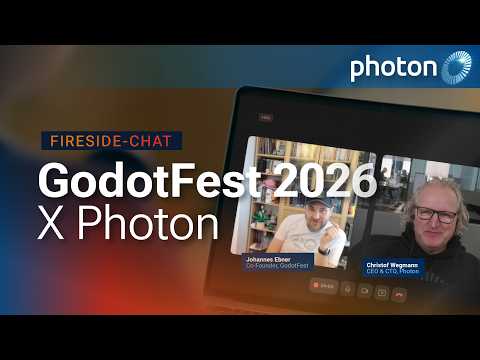
Ahead of the conference, our CEO/CTO Christof Wegmann sat down with Johannes Ebner, one of the cofounders of GodotFest, to talk about where the event came from, why so many studios are looking at Godot, and why we built Fusion for Godot on an engine-agnostic core. Below are the parts of the conversation we think Godot developers will find most useful.
Why Studios Are Looking at Godot | Fireside Chat with GodotFest’s Johannes Ebner
How GodotFest started
Christof and Johannes first met years ago at Nordic Game in Malmö. Johannes was working on Azure Cloud Gaming at the time, which made us competitors in the same space. They reconnected at GodotCon in Amsterdam last year, and the conversation quickly turned to GodotFest.
The team behind GodotFest organized the first standalone Godot conference in Munich in 2023. It was one of the first events after COVID, and it sold out in roughly two hours with over 200 attendees. The following year the Godot Foundation ran the conference in Berlin, and the GodotFest core team then brought Munich back as its own event.
Everyone on that team works in the games industry day to day. Raffaele Picca of Bippinbits, the studio behind Dome Keeper and PVKK: Planetenverteidigungskanonenkommandant, handles the conference art. Other members come from publishing, consultancy, and game development. That background shapes what GodotFest wants to be.
We really wanted to be the conference for professionals. We are games industry professionals. We know a lot of games industry professionals, and what we always like at conferences is to be in the same city at the same time. So we can say to our industry buddies in the Godot space: let’s meet in Munich again next year in November.
Johannes Ebner, Co-Founder GodotFest
Why studios are looking at Godot
Johannes sees adoption roughly doubling year over year since Unity’s license change. The absolute numbers are still smaller than Unity or Unreal, but the direction is clear. This year Godot was the most used engine in the GMTK Game Jam, and the interest isn’t limited to hobbyists.
“When I talk to developers, every company really looks at Godot right now. Really everybody,” he said. “Whether that’s small studios or big companies. I’ve talked to many tech directors who are evaluating Godot for their next project, or see where they can work with it. Maybe not the game itself, but additional tooling.”
He pointed to a few examples. Mega Crit moved Slay the Spire 2 from Unity to Godot mid-production. Battlefield’s Portal editor is built on a customized Godot editor. And behind the scenes, teams working on larger projects tell him they want the freedom that open source and zero license cost give them, along with the security of owning the engine version they ship on.
He also noted a practical side effect of Godot being open source: the docs are available in Markdown and many example projects are MIT licensed, which makes the engine a natural target for AI-assisted development.
We see the same trend. As Christof put it: “We’re convinced Godot will become an equal contender to Unity and Unreal in the coming years.”
Why a professional ecosystem matters
A lot of people on our own team use Godot for game jams and prototypes, and the way they describe it stuck with Christof: “Some people here in the company say, with Godot, game development is fun again. And this is really motivating.”
Fun alone doesn’t pay salaries, though. Johannes framed GodotFest’s purpose around that gap:
You need this commercial ecosystem around it. I would love to spend my day building games with Godot. But for that it needs a professional ecosystem. It needs developers, studios, publishers that build games with Godot, so I can make a living off of that. And that can only happen if there is a commercial ecosystem around it.
Johannes Ebner, Co-Founder GodotFest
That means console support (W4 Games took an important first step there), ad network SDKs for teams shipping on mobile, and production-ready multiplayer. Teams adopting Godot want professional solutions and contact with other professionals who have solved the same workflow problems. That’s the part of the ecosystem we want to help with.
Where Photon fits in
We’ve been building multiplayer tools since 2003, when Christof and five co-founders started Exit Games (still our company name) to bring multiplayer to Java-based games on Nokia phones with 64 KB of memory. We backed Unity early, and for about 15 years most of our products, from PUN to Bolt to Fusion and Quantum, were full C# builds tied to Unity.
Unity didn’t have proper multiplayer, so they were embracing everyone in the community to fix the hole. And I think Godot doesn’t have top-notch multiplayer. So we try to come in and build great multiplayer.
Christof Wegmann, CEO/CTO Photon
Porting a Unity-specific C# codebase to Godot wasn’t a realistic path. What made Fusion for Godot possible was an architectural change we made in Fusion 3:
We took the parts that are engine agnostic, which is 80% of Fusion, into C++, and then only write the last glue into the engine, into Godot, into Unity, into Unreal, to make it really feel like this is built for that engine.
Christof Wegmann, CEO/CTO Photon
That shared C++ kernel is Fusion Core. Fusion for Godot sits on top of it with a GDScript API that follows Godot’s node model, so networking code reads like regular Godot code. The same core compiles for desktop, mobile, and the web through WebAssembly. Web builds currently use WebSockets, and we plan to move to WebTransport now that most browsers support it, since real-time multiplayer benefits from UDP-style transport.
It took us 15 years to get to a single kernel that powers every SDK. Getting there meant hiring senior engineers who were willing to throw away a lot of existing code when a fresh approach made more sense, and Fusion 3 is the result of that.
Competing with free
We’re not the only multiplayer option for Godot. Steam includes a relay with its 30% revenue share, and W4 Games offers its own multiplayer tooling. We think that’s healthy. Competition pushes everyone to build better tools, and we have to earn our place on technical merit.
“We need to be better ultimately than what you get in Steam. Otherwise we cannot survive,” Christof said. Part of that is reach: Steam networking only runs on Steam. We’re testing Fusion for Godot on console dev kits and support web and mobile as well.
The other part is cost and operations. Photon Cloud runs on bare-metal providers rather than general-purpose cloud platforms, across 20 regions, which keeps hardware and traffic costs low enough for us to pass the savings on to developers. And when people ask whether AI makes it easy enough to build your own netcode, Christof’s answer is practical: “You still need the servers. There’s cost, it’s deployment. You need to worry about 24/7 NOC.”
We’re also realistic about the timeline. Studios and indies are picking up the Godot SDK now, but we expect it to take a year before the first projects ship and another before there are successful titles built on it. We’re planning for a three-year horizon, and we’re fine with that.
MeetToMatch at GodotFest
For Johannes, scheduled meetings are what turns a series of talks into a professional conference. With our support, GodotFest attendees can use MeetToMatch to see who is attending, including platform holders like PlayStation, and pre-arrange meetings.
“Business development is a long play,” he said. “You don’t get out of a meeting right away and have a deal. Usually it’s about making connections, talking about what excites you, how you can work together. And then you call each other and figure it out.”
Christof has used MeetToMatch for years, and our expectations are simple: “I really hope people use it and just reach out to people. I think it’s the best tool out there, and we wanted to help you sponsor it and say, let’s try it out together.”
Christof won’t make it to Munich this year because he’ll be in Tokyo, but two of our engineers will be there, including the developer responsible for the Fusion for Godot samples. If you’re working on multiplayer in Godot, come find them and bring your questions. You can book a meeting with them through MeetToMatch.
The keynote, and talks on YouTube the same day
Johannes is giving the opening keynote on day one: “Tools Change, Craft Remains: Reflections on Godot, AI and the Future of Making Games.” He described it as neither pro- nor anti-AI, but an attempt to make room for a discussion that has become polarized across the industry.
The reality is it’s probably not going to go away. We need to look at how those tools change how we make games. And I strongly believe that the craft still remains.
Johannes Ebner, Co-Founder GodotFest
All talks are recorded by the Chaos Computer Club‘s Video Operation Center and published on YouTube shortly after, often the same day. That’s a deliberate choice. “We don’t want to gate it,” Johannes said. The talks will be online for anyone, but the conversations that happen after a talk only happen in the room.
GodotFest 2026 at a glance
When: November 3 and 4, 2026
Where: Munich, Germany
Who: Professional Godot developers, studios, publishers, tool makers, and anyone getting started with the engine
Included: Food on both days, unlimited drinks, and MeetToMatch networking powered by Photon